

September 18, 2025 Edition
By Emily Patrick
In April, landowners in Maine’s Unorganized Territories received a letter from Maine Revenue Services stating they recently did a revaluation of Maine’s UTs, something that hadn’t been done since 2020. As a result, taxes more than doubled taxes for some of our neighbors.
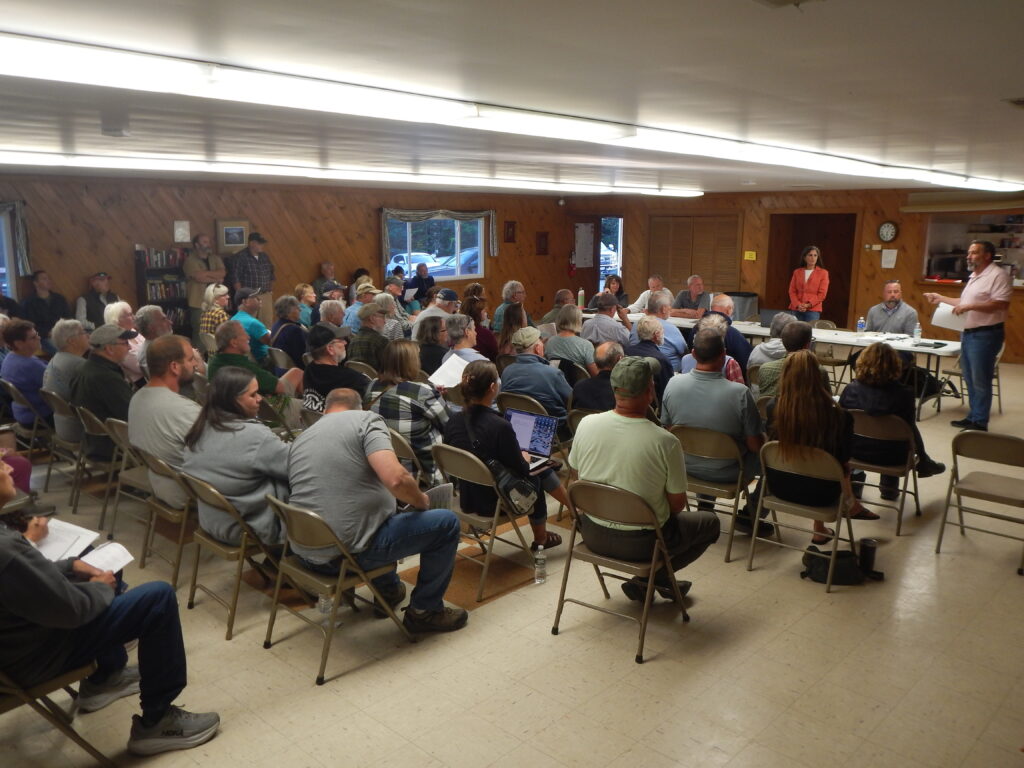
Representative Elizabeth Caruso from Caratunk called for a public meeting after receiving numerous phone calls from property owners looking for answers. Some called it a State “money grab,” others were just living on a fixed income and concerned about how they were going to pay taxes on a property that had been in their family for generations. At the opening of the September 10 meeting at the Rockwood Community Center, Caruso said, “The government works for you…We all care about making sure that everything is done correctly.”
The panel for the public information meeting did not deny that the new assessed property values went up by a significant amount. Moderator Tim Curtis, Somerset County Administrator, said although the mill rate went down almost 25%, overall valuation was up 37%, “because of the market we’re in.” He said Somerset and Piscataquis County consistently have the highest UT valuation in the State. There are 4,000 taxpayers in Somerset County’s UT alone that generate around $1.5 billion in taxes.
So, what do Somerset and Piscataquis County have in common? Waterfront. Namely, Moosehead Lake. Curtis said, “Waterfront property is the driving factor here,” later saying he agrees it’s “terribly unfair” waterfront property owners are experiencing a large increase in their property taxes while their neighbors are enjoying a decreased mill rate. This has effectively shifted the tax burden disproportionately to waterfront property owners. Still, Curtis said, it’s the job of Maine Revenue Services “to gauge and collect growth.”
Because a UT revaluation hadn’t been done since 2020, the panel pointed to increasing inflation and record-high real estate sales in the region as the driving factors of the increase. Justin McMann, MRS Tax Division Assistant Executive, said a large increase often happens all at once with a revaluation, because they are not done every year due to the prohibitive cost of undertaking a revaluation.
Steve Sullivan, MRS’s Deputy Director, echoed this sentiment, saying, “We as assessors for the Unorganized Territories…have to assess based on market value.” In Title 36 Section 327, the statute outlines “just value” as the standard for assessment. The Maine Supreme Court has interpreted that to mean “market value,” according to the panel.
Tim Curtis said, “The burden is on you [the property owner] to show your tax assessment is manifestly wrong.” The first step is to file an abatement with Maine Revenue Servies. Lisa Whynot, Deputy Director of MRS Property Tax Division, said the department has a team of five people that review all the tax abatements that come in, and that they are all reviewed individually. The department then has 60 days to respond with a letter to the property owner that will outline next steps.
John Willard, a local UT resident whose taxes doubled after the revaluation, asked what the department accepts for supporting documentation because, he said, “In my experience, it’s an automatic rejection.” He said the only way to get around an automatic abatement rejection from MRS is to have an appraisal done, which can cost the property owner up to $1000. He said in frustration, “It should be up to you people to get the appraisal right.”
“Is it a perfect process? No,” said Curtis, “but it’s what we’ve got right now.” If a property owner files for an abatement through MRS and is denied, the next step in the process is to contact the County Commissioner. If that step fails, the last option available to a property owner is to file an action with the Superior Court. Frustrated residents pointed out the burdensome cost of hiring lawyers and the time it takes to get a case heard. Representative Jim White, who lives in Guilford, told me after the meeting adjourned that we haven’t had a sitting judge in Piscataquis County for three years.
Senator Russ Black, who represents Senate District 5, Somerset County North of Madison, said, “The only way we can change what you’re asking for is to change the law. I represent rural Maine, but it has to come from the other representatives. [There are] four Senators in the Town of Portland. They’re four votes. I’m one vote for all this district.” He went on to say the only way he can change the law is to get other legislators to support a bill for the Unorganized Territories, but that they “don’t care” about UTs and, “Until you change the makeup in Augusta you can’t get anything changed there.” One member of the crowd suggested if everyone didn’t pay their taxes, it could start a revolution. Black said somberly, “Or have a revolution.”
Sullivan explained the way the revaluation was performed, using a “mass appraisal” approach. He said it’s impossible for MRS to go out to every property in the unorganized territories and do an appraisal. He said they, “do not have the time or staff or budget to do that kind of thing.” Instead, MRS looks at comparable real estate sales in the area, goes off of historical data about the property, and factors in the new market value of the land itself, any improvement to buildings or structures, or any depreciation that may have occurred to come up with the new assessed value.
Of course, there’s room for error in this approach. One attendee asked what factors MRS uses to estimate the value of a piece of waterfront property, because her pie-shaped piece of property is valued at nearly as much as her neighbors’, who have roughly the same amount of waterfront but more acreage and more valuable homes. McMann said MRS primarily uses front foot and depth of the property, which would artificially inflate the value of a pie-shaped piece of property because they’re going by front foot and depth, not acreage. And again, when MRS makes an error, the burden of proof falls to the property owner to prove the valuation was “manifestly” wrong.
So, with the large increase in their tax bill many UT property owners are now facing, it begs the question: what does this tax revenue support? Many property owners are claiming “taxation without representation,” due to the lack of services they receive in comparison to their neighbors who live in municipalities with central government.
Representatives present from Maine Revenue Services reiterated throughout the evening this was not done to raise money for the State through higher taxation, and pointed out that higher valuations typically lower the mill rate. Furthermore, taxes collected from Unorganized Territories do not go into the State’s General Fund, and taxes are not set based on assessed value alone, but also local, State and County budgets.
Still, Curtis said, “Clearly all of you are here because you feel like you’re being overtaxed for services you don’t receive.” Somerset County has the highest UT budget in the County, with funds being used primarily for snow removal, policing services and fire protection.
The gentleman next to me said he lives 45 minutes away from a fire department, and by the time they arrived, any structure on fire would be burned to the ground. Another in the back scoffed, saying the sheriff’s department is an hour away from where he lives, and the only UT road that is maintained is Route 15. “You guys think this is a big joke,” he said, referring to the panel. “It’s not a joke when you’ve worked all your life to buy land on a lake that you’ve come to all your life.”
Thad Moody, local resident, admitted the large tax increase was not the panel’s fault, but said it was “poor timing” with all the challenges Mainers have faced since 2020, including inflation, increasing lack of access to critical services, and the ever-contentious pine tree license plate. He said, “We don’t want to sell our properties, [but we are] getting forced into the position we have to sell.”
Representative Caruso said that we “definitely need a change in the law” and that Covid exposed a lot of weaknesses in the system. She went on to say it’s “crazy” how the value has gone up on camps people have owned for generations because people think they can spend three to four times the market value for properties in our region. Many local, year-round residents can’t compete. “Most of these people want to stay, but are going to get squeezed,” one resident said.
One individual asked the panel if the housing market represented a normal market. McMann said, “It is, it’s out of the norm…It’s not normal, but it’s now become the norm.” The attendee then went to point out that the definition of “just value” in the Maine State Constitution the panelists kept pointing to in order to justify the increase also assumes “normal conditions” in the market.
In fact, on Maine.gov in a MRS training handbook, it states, “The Maine Constitution requires, ‘all taxes upon real and personal estate, assessed by authority of this state, shall be apportioned and assessed equally according to the just value thereof.’ In keeping with this constitutional provision, state of Maine law requires assessors to perform annual sales ratio studies (36 M.R.S. § 328(8)).
When undertaking a sales ratio study, it is important to use data representative of the market. All sales used in a sales ratio study must be unbiased sales, referred to as arm’s-length transactions. An arm’s-length transaction is a sale between a willing and informed buyer and a willing and informed seller, neither under any undue pressure to buy or sell, with a price expressed in dollars. The property sold must have spent a reasonable amount of time available for sale and normal market conditions must exist.”
Representative White said there are places selling for 400-500% of their “normal” value, and that, “No one can stand here with a straight face and say this is a normal market we’ve been going with the last four to five years…This hasn’t settled yet.” He said those who work for Maine Revenue Services are not the enemy, but they’re being pressured to do a revaluation of a market that hasn’t been settled out yet because the State budget has grown exponentially in the last 5 years.
At the end of the meeting, the crowd left still angry, confused, and scared of what the future is going to look like. Representative Caruso agreed there needs to be change, and there are teams in Augusta who are “looking at property tax” right now. Senator Black said as more municipalities see the same large increase the UTs are facing, more attention may be drawn to the issue and, maybe then, something can get done. Residents looking to file a tax abatement can call Maine Revenue Services at (207) 624-5600.