

By Emily Patrick
In August, the Moosehead Lakeshore Journal reported the Department of Inland Fisheries and Wildlife was considering a change to Maine’s moose hunt that will impact Greenville and the larger Moosehead Region.
The proposed change would add a September moose hunting week in addition to the existing week of hunting already in place for October, with a week in between, moving the October hunt forward. According to the State, the total number of permits would not increase, but would be split between the September and October week. This change would apply to Wildlife Management Districts 8 and 9.
Greenville is the biggest population center in WMD 9, while Rockwood and Jackman lie in WMD 8. Greenville is unique in that its fall economy is largely based on leaf peepers and moose watchers, not hunters. It’s no surprise, then, that opposition to changes in the moose hunt is not new in the Moosehead Region.
In 2015, the Piscataquis Observer reported widespread opposition to increasing the number of moose permits at a meeting held in Louis Oakes Auditorium. Staff Writer Mike Lange reported, “The economy of the Moosehead Lake region depends a lot more on moose watchers than moose hunters. That was the message strongly conveyed at Friday’s public hearing at Greenville Consolidated School.”
Lange reported that, of 125 people in attendance, two dozen spoke in opposition of the proposed increase, while only two spoke in favor of the Department’s proposal. August’s meeting mirrored the historical trend, with local hunting guides, Registered Maine Guides, business owners and concerned citizens all speaking out in opposition of the Department’s proposal.
While much has changed in the Moosehead Region in the last decade, attitudes towards moose management apparently haven’t, and neither has the makeup of fall visitors.
According to the Maine Office of Tourism’s 2024 Fall Visitor Tracking Report, which collected data from September through November of 2024, over 2.6 million total visitors to Maine generated over $2 billion dollars in direct spending. Of those visitors, 34% reported they came to Maine to view fall colors, 30% for hiking/backpacking/climbing, 29% for photography, 22% for wildlife viewing and bird watching, and 21% for nature cruises or tours. Fall hunting? 5%.
Our local Visitors Center reports a similar breakdown. From Lew-Ellyn Hughes, Destination Moosehead Lake program planner and professional “greeter”: “In 2025, 5,243 folks stopped into the DML Visitor Center and signed the guest pages. August (1,166 folks) and September (1,060 folks) were the busiest months, with October third at 896 people, mostly here for fall foliage. A vast majority of people who walk through our door ask where they can see a moose, followed by folks seeking hiking information. Moose Safari information was second on our website analytics for 2025.”
Despite the current widespread opposition to extending the moose hunt, and historical opposition in our region, the Department is planning to move forward with its proposal and has scheduled a public hearing for the day of this publication.
IF&W says, “Adding additional WMDs to the September season will increase moose hunting opportunity without increasing permits and reduce hunter and user conflicts by redistributing hunters.” However, from the Department’s own data garnered from a 2024 study conducted by Responsive Management: “Only 10% to 14% of guides and 2% to 8% of hunters, recreationists, and anglers say crowding is a major problem.”
IF&W also claims the survey suggests more Mainers approve of this proposed change in legislation than oppose. However, from the same survey results: “Most residents, hunters, recreationists, anglers, and guides indicated that they want the season structure to remain the same.”
I spoke to a number of local hunters, guides, business owners and citizens about the proposed change and tried to understand: why all the opposition? The common themes were concern over the health of the herd, and the negative impact this would have on Greenville’s economy.
The State won’t argue that Maine’s moose herd is in decline, but identify the culprit as winter tick rather than hunting practices. State biologists know from other parts of the United States that higher population densities of moose mean more ticks, but opponents disagree that killing more moose is going to solve the problem. The State of Maine was supposed to wrap up its Adaptive Management study in 2025, which was testing their theory that thinning out the herd would mean less tick mortality, but as of right now, that data is unavailable, as is any direct evidence supporting killing more moose to solve the tick problem.
IF&W Communications Director Mark Latti says, “2025 was the final planned year of the Adaptive Moose Hunt, and the rulemaking proposal includes eliminating this hunt for the fall 2026 hunting season. We are continuing to collect data from moose in WMD 4 during the winter and spring of 2026, and will begin analyzing the results later this year.”
While we wait for clear data to support the State’s management approach, the herd continues to decline. From IF&W’s own data, we can see that, while moose permits have increased 310% since the 1990’s, the moose population has reduced by about 25%, from 70-80,000 to only 50-60,000 in 2024. In addition, harvest weights are down from a historic weight of 1,106 pounds to an average of just 715 pounds in 2023. Trophy antler spreads are down 26%, suggesting an increasingly younger herd. This mirrors what hunting guides are seeing in the field. Experienced hunting guide Bob Lawrence says during last year’s hunt, he only “saw 5 small bulls.”
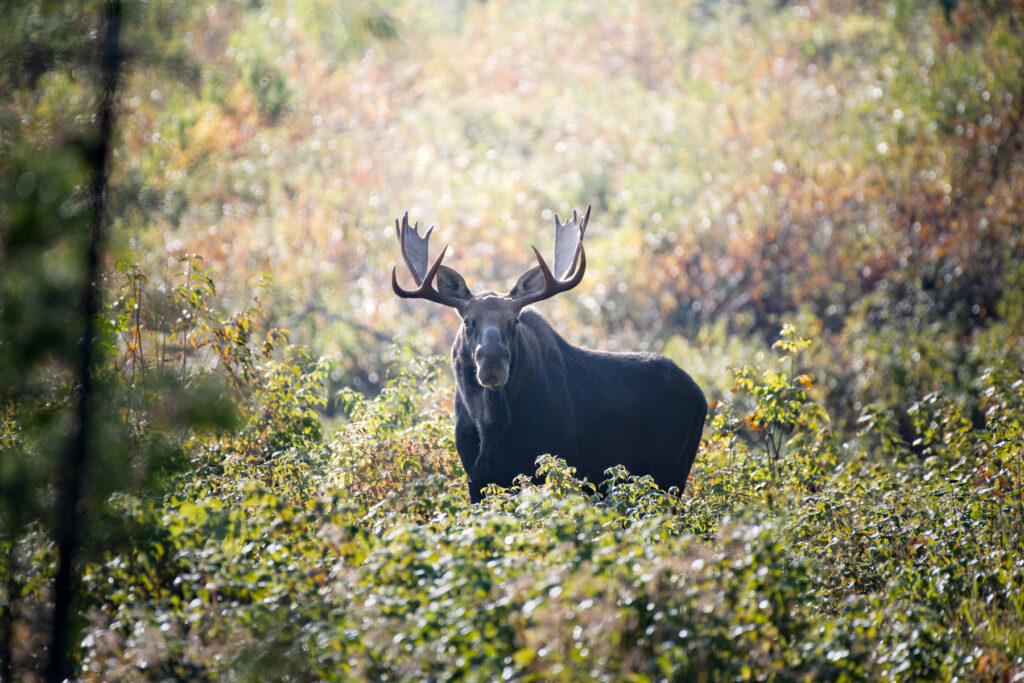
Adding a September hunt would mean more big bulls would be tagged when they are most vulnerable: peak rut. This, of course, would mean their genetics won’t pass on.
We must also consider the economics at play. While the data suggests more visitors are coming to the Moosehead Region in the fall to see a moose alive than to tag one, it’s important to hear how this will affect real business owners in our area.
Local hunter and hunting guide Chris Young of Young’s Guide Service says, “I’ve been doing this my whole life…I have a life pursuing these animals [and] the stuff I’ve learned from them…it’s totally the opposite of what the State’s telling people.”
Young believes the State’s proposal is, “just another tool to kill more moose to make more money…It’s never, okay, let’s decrease permits in this area and see what that does.”
“IF&W does not get one red cent from the state for their budget…their income is from license sales,” said Don Lewis of the Bear’s Den in Rockwood.
From IF&W Communications Director Mark Latti, “Last year, the Department brought in $2,132,297 in revenue related to moose, which helps fund moose and other wildlife research. Revenue collected by the department goes directly to the department, as specified in the Maine state constitution. The department is primarily funded through the sale of license, permits and registrations. The Department’s total budget is about $85 million, so approximately 2.5% of the Department’s total budget is related to moose.”
If this proposal goes through, “This will 100% destroy my business,” Young said. “I’m 47 years old; I’ve devoted three-quarters of my life to moose…moose is what I know. I don’t really know if I want to do something different,” Young said, adding, “It’s not just me that’s going to be affected by this, it’s going to be the whole town.”
Jeremy Hargreaves, owner of Northeast Whitewater in Shirley, Maine, started out guiding rafting trips, but has seen a 70% decline in rafting since establishing his business in Greenville in 2007. Now, approximately 40% of Hargreaves’ revenue comes from guiding Moose Safaris. In only 9 days last October, Hargreaves guided 349 people on moose tours. He relies on that last bit of revenue flow to help his small business get through the slow winter months.
Moving the October hunt forward, as the State is proposing, would take away that fall income stream. What’s more? Most of his guides are hunting guides, and changing the moose hunt will take away most of his staff members during a time when employees are already scarce. Hargreaves also points out that, although the State is citing hunter conflict as a reason for adding a September hunt, doing so would take a whole “user group” from October and put them into September. “Now there will be more conflict with a user group that doesn’t understand the other,” he says.
“This is about the viability of a community that has built themselves around people coming here for moose,” Hargreaves concludes, pointing out it’s not just him he’s worried about, but the entire community.
“The health and sustainability for the future of Maine’s moose herd has nothing to do with your political thoughts,” Young says. “It has to do with…do you remember when Moosehead had moose?”
The thoughts and opinions expressed in this article are in no way meant to diminish the economic value or cultural significance of Maine’s moose hunt. As I stated earlier, everyone interviewed for this article is a hunter themselves, a hunting guide, or both. In talking with these individuals, it’s clear they value Maine’s hunting heritage…and that’s precisely why they want to ensure the health of the herd.
Everyone in Maine relies on moose in one way or another. In doing research for this article, I’ve come to think of them as a precious commodity, like silver or gold or oil. Similarly, when they’re gone, they’re gone: we can’t make more. Ensuring the health of the herd means future generations can enjoy moose in any way they choose, whether that be viewing, photographing, or hunting. As Chris Young said, once there are no moose in Moosehead, we just have a lake.