

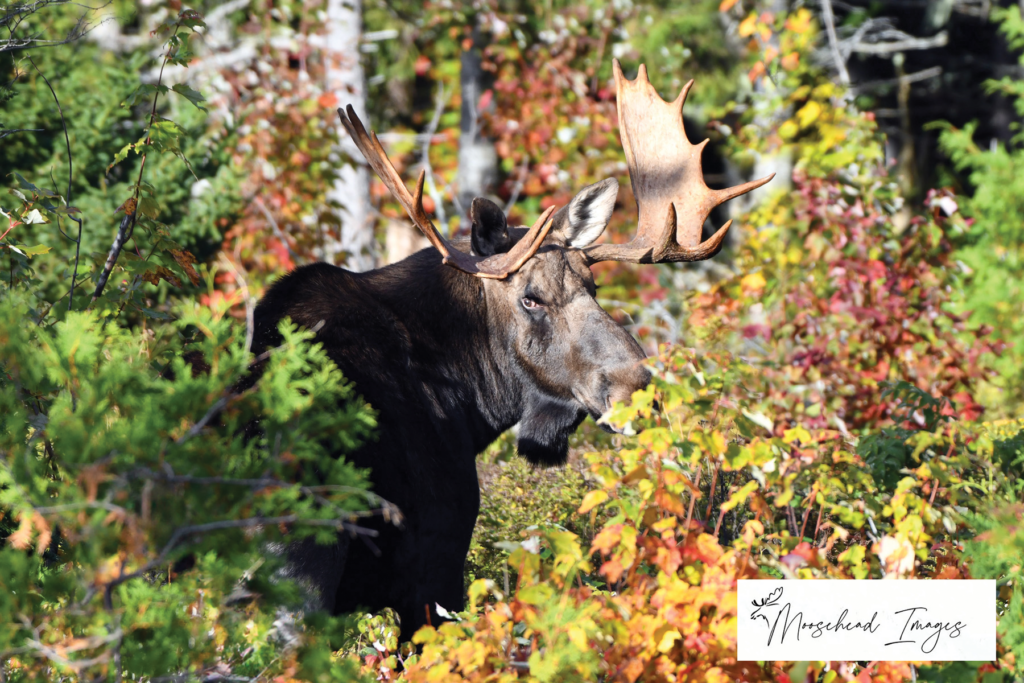
Courtesy 9-4-2025 Edition
By Emily Patrick
A closed meeting between the MDIF&W, Greenville’s selectmen, and select area businesses was held on Tuesday, August 19 2025. The topic of discussion was a proposal by IF&W to open a bull-only hunt for 6 days in September in WMDs 7-9, 12-15 and 17.
To give you a bit of background: Maine has the largest moose population in the lower 48 states. In fact, one of Greenville’s claims to fame has long been “Where moose outnumber people 3 to 1.” Still, that hasn’t always been the case. Due to habitat change and hunting, as well as other factors, Maine’s moose population was seriously threatened by the 1930’s, so much so, the legislature banned moose hunting altogether.
The population eventually rebounded due to a number of factors. In 1979, the Maine legislature reinstated the moose hunt, but not without controversy. Still, the bill passed. Then, in 2000, the Maine Legislature granted IFW the authority to establish the timing and extent of the moose hunt.
For years, the hunt was limited to 6 days in October. Maine’s remaining wildlife management districts were opened for both a September and October hunt in 2001 and then again in 2018, and it’s part of IFW’s Big Game Plan to reopen the remaining districts. Greenville falls under WMD 9.
Despite the controversy and the importance of moose to Maine’s economy, it wasn’t until
According to IFW’s Information Sheet on the proposed September moose season in WMDs 7-9, 12-15 and 17, the goal of splitting the bull season into a separate September and October season is to “distribute hunters” and “meet management goals.” They say, “Adding a 6-day September Bull-Only season will not increase the number of moose hunting permits issued in these WMDs but will split the existing number of permits between the September and October season. IFW is seeking input and feedback from town officials on this proposal and will be available to answer questions and concerns.”
While town meetings in other districts, such as Eustis, were open to the public, it appears the intention of public officials was to keep the Greenville meeting closed. In his invitational email, town manager Mike Roy said, “This meeting is not a public hearing, but a fact finding, listen to comments session and to provide feedback to those local businesses which may be impacted.”
According to IFW, WMDs 7-9 and 12-14 were not opened because of “perceptions regarding public acceptance.” They state, however, a recent survey indicates “stronger support than opposition for adding a September Bull-Only season in the remaining WMDs that did not currently have a September season.” The survey can be found at mefishwildlife.com/moose.
Additionally, the Department believes the proposal could alleviate congestion during the October hunting season, provide an economic boost in September for local communities, and “bring additional opportunities to moose hunters.” The department also states they have not received any negative feedback or impacts” in districts that added a September season.
As word of the meeting spread, comments from locals and visitors were divided, with many echoing Henry David Thoreau’s sentiment that moose are more valuable alive than dead, and still others claiming a high population density is contributing to more ticks and the declining health of our local moose populations.
It should be noted that, although moose research in other parts of North America shows that moose that live at low population densities have fewer ticks, and IFW is currently carrying out an Adaptive Management Study to determine if moose density reduction can help solve the winter tick problem in Maine, at this time, the study is not complete and there is no evidence clearly showing a link and the tick/density “problem”. Please see https://www.maine.gov/ifw/fish-wildlife/wildlife/species-information/mammals/moose-winter-ticks.html for more information.
On the flip side, we do know that the breeding season for moose, or the “rut” begins in September, and IFW has suggested that calves are much more likely to die from a tick infestation than adult moose, and that controlling the cow population is more effective at suppressing the population than hunting males (or bulls). So, it begs the question: why is the proposal to open bull hunting for an additional week in September, during the rut, if controlling the cow population is a more effective management strategy? Would opening an additional week of hunting in September reduce the number of calves produced that year, and if so, why is this a proposed management strategy when the main concern seems to be an increasing number of calf deaths?
One commenter stated the importance of moose watching to Greenville’s economy, and the ripple effect just one moose-watching excursion had: “This last trip we rented an Air BnB for 4 days, ate lunch and dinner at places like Kelly’s Landing and the Stress Free Moose, went on a private tour, had coffee and dirty sodas at Greenville Grinds, had ice cream at the Dairy Bar, got some delicious goodies form the Northwoods Gourmet Girl, went on the Katahdin cruise when we came last fall (one of the most beautiful experiences); we purchased some souvenirs at Northwoods Outfitters and Mud Puddle Mercantile, just to name a few places…We even branched out to surrounding towns and went to the Abbot Bakery to bring home some blueberry pie for friends, went to Turning Page Farm and Brewery in Monson to have some lunch and local beer with goats, and Misty Mountain Farm in Blanchard for some of the most amazing all-natural lotion and bug spray.”
Though the proposal would not increase the number of tags in District 9, some commenters expressed their concern the additional hunting days could lead to more tags being fulfilled. Others argued each tag only allows for 6 hunting days, no matter when they are. To me, the confusion only highlights the need for a public meeting between IF&W and Greenville residents and visitors.