

Moosehead Lakeshore Journal 9-18-2025 Edition
By Emily Patrick
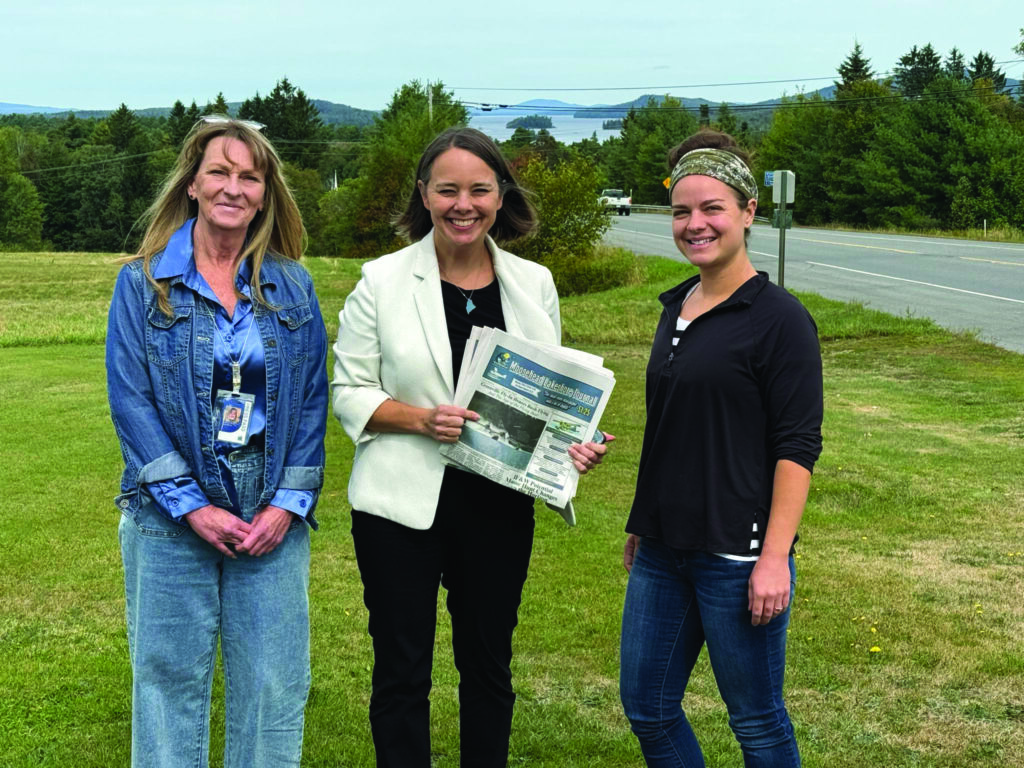
During her recent visit to the Moosehead Lake Region, Maine Secretary of State — and gubernatorial candidate — Shenna Bellows sat down with us to talk about her vision for Maine’s future, the challenges facing rural communities, and why she believes listening to every corner of the state is key to leadership.
Q: What brings you to the Moosehead Lake Region today?
Bellows: “I’m here to meet with voters. We’re having a small campaign event to chat about the issues that matter to this region. I believe that Maine’s next governor needs to be governor for the whole state. That means I’m traveling everywhere to every corner of the state to listen and hear what’s on people’s minds.”
Q: Have you visited before?
Bellows: “My husband and I vacationed here in Greenville. I’m trying to remember what year that was, but we loved it. We were here for almost a week. We went out on the lake, and we hiked a ton, and we ate good food and just enjoyed the beauty of this region. We also looked for a moose, and we didn’t see moose here, which was deeply disappointing. But of course, we’ve seen moose…because we’re both Mainers.”
Q: If you could spend a free afternoon here in Moosehead, what would you do?
Bellows: “I think I’d go out on the lake, and maybe I would climb Kineo.”
Q: What does a “day in the life” of Maine’s Secretary of State look like?
Bellows: “What I love most about my job is every day is different. As secretary of state, I oversee Maine elections, corporations, the Bureau of Motor Vehicles, and Maine State Archives. I ran on a platform of modernizing our services to better serve the people of Maine. We’ve done a lot on that front. We implemented automatic voter registration so people can register to vote when they go to the Bureau of Motor Vehicles and online voter registration so folks update their registration or register to vote online.
The next big thing at the BMV is we are working on a mobile unit. So, imagine a BMV in a van that could come here to Greenville and be here once a month or here at the senior center so that seniors could get their license renewals, their IDs, or whatever else they need from a BMV without having to travel hours to Bangor or Augusta. I brought appointments to the BMV. So, if you can plan ahead, you can get in and out in a very brief time without waiting. But I recognize having grown up in a rural area myself, that it can be really challenging for people who live busy lives to get to the service centers where so many government services are.”
Q: What part of your job do people often not realize falls under your office?
Bellows: “I think a lot of folks don’t realize that the secretary of state is the guardian of all of the records of the state. Those are held at Maine State Archives. My favorite is the original Maine constitution and the drafts of the constitution. We literally have the documents where some of the founders of our state crossed out words in the original drafts and put in other words. So that’s one of the fun parts of my job.
We have historic maps of the state. We have court files from the 1800’s documenting some of the big legal cases that helped shape our state. We have petitions for when women were first seeking the right to vote in Maine. It’s really a treasure trove, and it’s accessible to any Mainer that wants to come visit us. Additionally, one of the things I really focus on is scanning those historical records so people can check them out online. We actually have the biggest collection of civil war records of any state archives in the country because more Mainers per capita served in the civil war on the side of the Union than any other state.”
Q: That was actually another question: your favorite artifact or piece of history or fact.
Bellows: “When I was a kid, I had a copy of the Bill of Rights on my bedroom wall. I was a constitution geek. And so, as secretary of state, there’s a framed copy of the original Maine constitution on the wall of the Secretary of State’s office.”
Q: What’s been one of the most rewarding experiences in your role? The most challenging?
Bellows: “The most rewarding and most challenging are flip sides of the same coin, like so much in this life. It has been challenging at the state level to implement new ways of doing things, to be more efficient and to cut red tape for people. It’s also been incredibly rewarding. When we are able to get people what they need more quickly and as responsibly as possible…that always feels good, whether that is making it possible for people with disabilities who had not previously participated in the election to be able to vote because they can register online, request their ballot online, have their ballot sent to them, and cast that without leaving their home if leaving their home is difficult for them.
At the BMV, we have really focused on customer service, and when someone has an emergency situation, they can call us, and we can give them a license or an ID same day. That same day service is something that always feels good because usually those circumstances are really difficult for people.”
Q: Approximately 60% of Maine’s population is estimated to live in rural areas, like Greenville, but many feel they are underrepresented in State and Federal government. If you are elected as Maine’s governor, how will you ensure the voices of rural voters are heard?
Bellows: “I will be governor for the whole state. Having grown up in Downeast rural Maine as the daughter of a carpenter and a mom who did a bunch of things to make a living, I am acutely aware of what it’s like to really be challenged by living in rural areas and be so far away from Portland and Augusta or even Bangor. I will work hard to ensure that people in rural areas have good jobs, access to health care, housing, and access to the government services that everybody needs like the BMV.”
Q: With the recent explosion of real estate prices in the Moosehead Lake Region, many residents are concerned they will be “priced out of paradise” due to rising taxes, lack of public access to increasingly-privatized expanses of land, and wealthy out-of-staters who are able to pay far more than market value for local real estate. If you are elected governor, do you have a plan to ensure lifelong Mainers are able to continue to live and work in the areas they know and love?
Bellows: “This is the issue of our time because since the pandemic, we have seen more and more people come into our state and prices for real estate, whether it’s rentals or ownership, have just skyrocketed. And they’re pricing your average Mainer completely out of the market. The state has to step in, and we need to do three things:
We should pursue public-private partnerships to rehabilitate derelict housing and make it available affordably to people who need housing. We should support first time home buyers, so those folks who are trying to buy a home- we should be making it as easy as possible for them. Perhaps the state can help with their down payment.
I think the state should invest in a housing core, so put people to work learning a trade, because one of the challenges is the shortage of builders and electricians and plumbers who can do the new builds, and that has also led to skyrocketing prices. I would like to see the state create a housing core to put young people who are looking for work to work in the trades, teach them skills and skills to run their own businesses, as well as pay them during a two-year period. And then afterward, best case scenario, they open their own carpentry or plumbing or electric businesses and contribute to a more affordable housing market. Worst case scenario, they’re a lot better at fixing up their own homes.
I also think the state puts a lot of money into affordable housing development through the private developers….affordable housing tax credits are incredibly important. We should continue that. However, there are a lot of nonprofits who can’t access state dollars and are interested in localized housing solutions. As I’ve been traveling the state, I’ve been talking to local nonprofits who are starting to try to work on housing and looking to the state for some supports to set up public matches for private dollars so we can make local decisions about having housing.
…The other thing that is really harming folks getting into housing are property taxes. We see seniors losing their homes because they can’t afford to continue to pay property taxes because of the pressures on the housing market. The state really needs to take responsibility for education funding and things like special ed and really think about how do we lower property taxes for your year-round Mainers…perhaps we need to reexamine whether there is a basic rate for year round home ownership and a different rate for Airbnbs and for our seasonal residents. Because if you can afford to have a second or third home, you can probably afford to pay your fair share of the taxes while not taxing out the folks who are already here.”
Q: Rural Mainers have historically had less access to critical services, such as healthcare and education. Now, their access to healthcare is less than ever before, with many critical rural hospitals closing. If you’re elected Governor, do you have a plan to help alleviate this crisis?
Bellows: “One of the focuses I will have as governor is rethinking how we fund rural health care. Just because it isn’t profitable doesn’t mean it isn’t necessary. If you can’t access a walk-in clinic when you’re in trouble or a birthing center to have a baby safely where you live, then people are going to leave. They’re not going to be able to stay. So, we really need to improve health care access in rural areas to support local economies and to continue to support growth of our state…In the absence of federal support for health care funding, the state is going to need to focus on core priorities. We can’t do it all, so we need to focus on what matters to all learners. Health care, good schools, the basic building blocks of our economy and not all the extras.”
Q: Many of our neighbors owning property in Unorganized Territories in and around Moosehead Lake were recently shocked at their new assessed value and the subsequent increase in their property taxes. Proposed Bill LD 808: LR1216(01) provided that “an increase in the assessed value of a parcel of land in the unorganized territory that exceeds 25% of its previously assessed value must be phased in so that the assessed value of a parcel of land increases by no more than 25% in a single year.” It did not pass the rulemaking process. If a bill like this were to come up in the future, would you support it?
Bellows: “Yes. We need to get property taxes under control. It is harming our state.”
Q: The majority of rural Mainers vote Republican. With party lines more divided than ever, how will you win their vote?
Bellows: “I won a state senate district that voted for Trump and voted for me in 2016. I grew up in a Republican rural area. Half of my family are Republican. Well, half of my family doesn’t care about politics. But of the half that do, half are Republicans and half are Democrats. We need to get back to a time where we can talk to everyone, and I am really proud of my work as secretary of state to bring Republicans to the table in modernization efforts for the BMV. The BMV mobile unit was a unanimous project with both Republicans and Democrats backing its creation. That’s what we need to do.”
Q: And you keep coming back to issues that matter to all Mainers. Maybe that’s where we can find common ground. You know, we can talk about these really abstract things, but things that everybody cares about, I think people are more willing to say, let’s find a solution.
Bellows: “Everyone cares about lower property taxes, good jobs, health care access and affordable housing. So, let’s start there.”