

By Emily Patrick
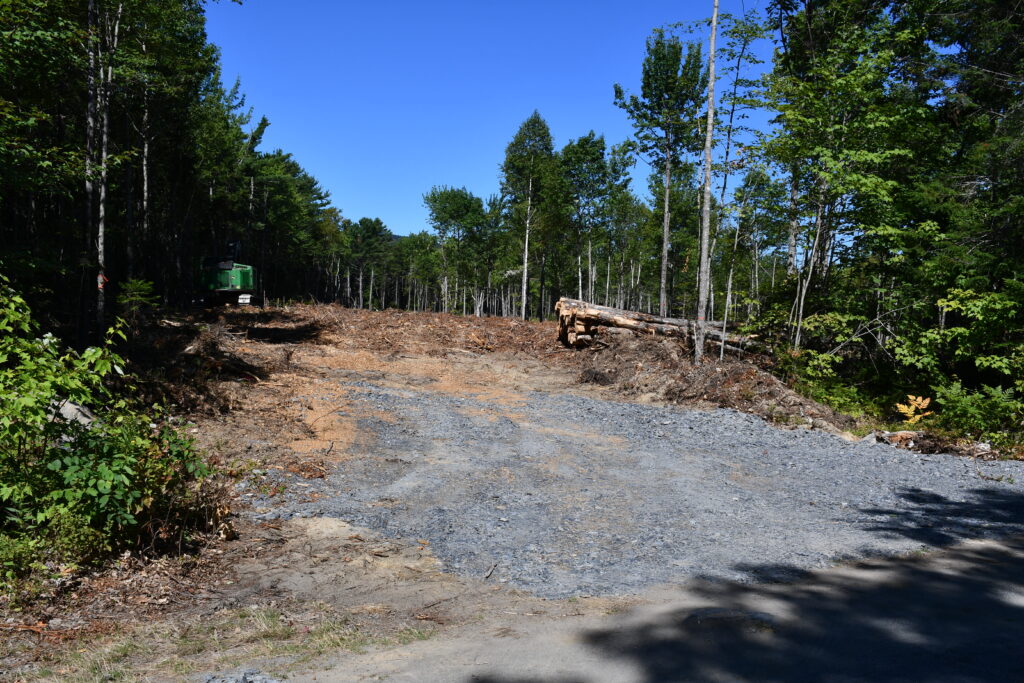
We have been following the progress of a new residential housing project on Spruce Street in Greenville since our June 12, 2024 edition. Recently, some project updates sparked conversation- and concern- amongst residents and visitors alike. I recently spoke to Mike Wilson, Senior Program Director for Northern Forest Center, to clarify the intent and scope of the project.
According to Wilson, NFC has a long history in Greenville working with local business owners and assisting in some development work. When the opportunity came up to purchase the Spruce Street parcel, which was identified as a potential housing development site as early as 2007 before Plum Creek’s development plans fell through, they saw it as an opportunity to address the glaring housing issue in our region.
Wilson sees no conflict between NFC’s mission and the development of the Spruce Street parcel. He says, “We understand and respect the long history of forest management…in the region. We also understand the need for housing.” The parcel’s walkability to downtown and accessibility to amenities, paired with the need for housing in the area, made it an ideal candidate for housing development. Not only has this piece of land been marked for development for decades, NFC is committed to moving the project forward in an ecologically-conscious and sustainable way.
The homes will be built using mass timber construction. Mike says, “In doing that we hope not only to build quality homes and help address some of the cost challenges, but also demonstrate innovative uses of wood that can be sustainably harvested from the forest.” This project will serve as a testing ground, potentially demonstrating and developing new markets for wood to help address the housing challenges not just in Greenville, but in our region and state.
Further, the wood harvested from the site will be transformed into wood pellets at a mill in Athens. When they’re then burned as a locally-produced, carbon-wise source of heating in Northern Maine homes, the journey will have come full circle.
Another fact to consider is that in a long-term thriving, economically viable community, “…more people are able to care for the natural environment.” Unfortunately, Wilson says, “We’ve heard consistently for years from local employers, the biggest challenge they face in attracting and retaining employees is housing.”
Wilsons says NFC has confidence in the Greenville/Moosehead Lake Region economy, and this project serves as a very real “vote of confidence” in our area’s future. Wilson hopes long-term, affordable housing options will attract those who already live in the area but can’t find permanent housing, as well as those who would like to work here but can’t find housing, and those who may even bring jobs with them to the area.
Though “affordable” is a subjective and even, at times, inflammatory term, and Wilsons says he recognizes not everyone will be able to afford to rent or buy these units, NFC “remains as committed as we can be to making these homes…accessible to middle-income earners in the region.” These are not going to be million-dollar properties, Wilson says, and not traditional income-restricted units. The target market is, “employees at the hospital, teachers, municipal workers…” Further, deed covenants will be built into the properties that restrict their availability to be used as short-term rentals or seasonal homes.
The bid package for the water, sewer and road for the project recently went out and the Town has begun to receive bids back. Wilson hopes this phase will be completed in the next couple of months, and Phase 2, site work and construction, will start next spring. The project is still on-pace to be completed by 2027.
Greenville is one of three focal communities for NFC in Maine, Millinocket and Bethel being the other two. As the Millinocket project is a bit further along than Greenville’s, it may serve as a yardstick for measuring the future success of the Spruce Street subdivision. Wilson says the new homes NFC built in Millinocket have been “consistently full” and he’s heard a lot of positive feedback from the hospital and other local employers that they would not have been able to attract employees if those units were not available downtown.
In closing, Wilson said, “We know that there will be ongoing questions about this project as it develops. We’re committed from a mission standpoint to really staying focused on this need and opportunity to produce affordable, middle-market housing” for earners in our area.
Where will the Mass wood building products come from?
Are the homes going to be Energy Star rated or Net Zero Ready, or at least all electric and use Cold Climate Heat pumps?
If not, what energy saving features will there be.