

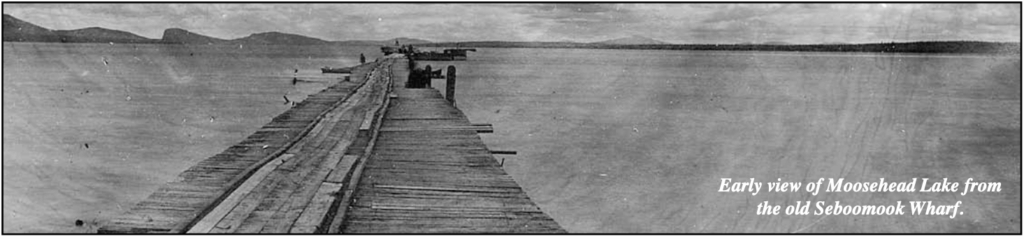
Courtesy MHS Insight Vol. 18, No. 1
January 2011
Have you ever heard of Moosehead Lake “turning over” during the summer months? Of course, it’s not physically possible for the lake to “turn over” in the sense of the bottom coming to the top, but it is a phenomenon which fishermen have recorded over the years, and is usually accompanied by large wave action on extremely hot days of summer. An article in an undated issue of Down East Magazine in the Moosehead Historical Museum archives re- cords such an incident in 1949. The article was written by F. Whitehouse Anderson, and here is what it had to say.
“The heat had been blistering all New England for three days running in late July 1949. On the 31st, with an official temperature reading of ninety-nine at Bangor, there was a steady influx of motorists to Moosehead Lake, Maine’s larg- est inland body of water, forty miles long and fifteen miles across at its widest point. The visitors sought relief from the heat on the lake’s sprawling expanse, and in the cooling shadows of its surrounding peaks.
“Yet nowhere on the lake was there much escape. The occupants of the hundred or so boats scattered over the water rode a surface that was like black glass … not a ripple, not a breath of wind. Then, suddenly, Old Dame Nature yawned and stretched. Earl Holt of Surry, who provided the following eye-witness account of the phenomenon, was fishing off Farm Island when the Mighty Moosehead decided ‘to turn over.’
The force behind this prank of nature, as explained by Kief Havey, State Biologist of Regional Fisheries, was primarily a matter of water weight and temperature. Water is heavi- est at approximately 39 degrees Fahrenheit. At temperatures above and below this point, it is lighter. When a lake is ice- covered, the water just under the ice is about 32 degrees, with the temperature rising slowly as depth increases, until
“As the day wore on, the heat became stifling. We hadn’t landed a fish, nor had we had a strike. I was about to ask my companion, who was running the motor at a slow trolling speed, to open it up in hope of creating a breeze, when I noticed the black surface of the water had changed to a rusty tint. It was three o’clock, and at that time we were about a mile out from Farm Island. Suddenly, a low, moaning sound came to my ears. There wasn’t a breath of wind, yet down the lake, I saw monstrous waves rushing toward us.
When the ice leaves a lake in the spring, the surface water begins to warm, approaching the lake’s temperature at low- er depths. When equality is reached, the “turnover” takes place, with even a light local wind action setting the entire lake in motion as the bottom water is forced to the surface, while surface water drops.
According to Mr. Havey, the explanation of the sudden, towering waves on the otherwise windless July day resulted from a small, local squall somewhere on Moosehead. The intense heat of the preceding had According to Mr. Havey, the explanation of the sudden, towering waves on the otherwise windless July day resulted from a small, local squall somewhere on Moosehead. The intense heat of the preceding had so penetrated the depths of the lake that water temperature conditions approximated an almost perfect “turnover” balance, similar to that in the spring. As a result, the mildest breeze was enough to set the entire tremendous expanse of water in motion, accumulating force and mass like a snowball rolling downhill. Old Dame Nature wasn’t in an ugly mood at all — she just wanted to play!